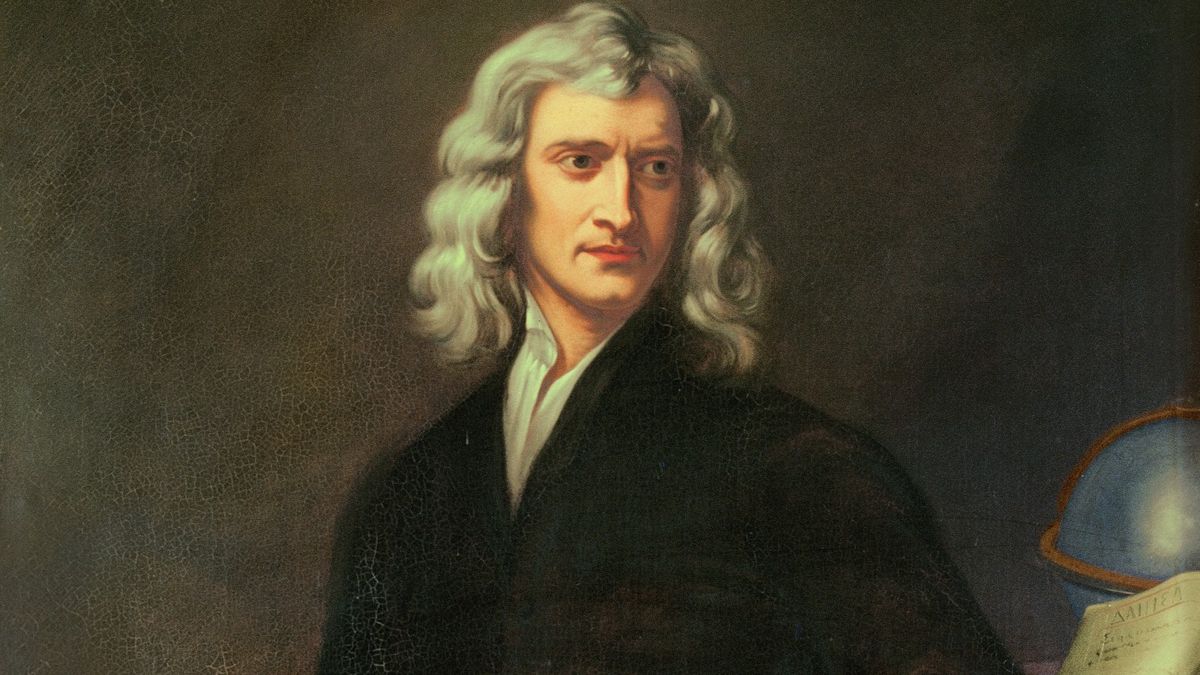
Sir Isaac Newton was one of the greatest scientific minds in history. His discoveries in physics, mathematics, and astronomy transformed humanity’s understanding of the universe. From the laws of motion to gravity and calculus, Newton built the framework of modern science.
He remains one of the most influential thinkers ever born.
Quick Facts
Full Name: Sir Isaac Newton
Born: December 25, 1642 (Old Style) / January 4, 1643 (New Style)
Died: March 20, 1727 (Old Style) / March 31, 1727 (New Style)
Birthplace: Woolsthorpe, England
Nationality: English (British)
Field of Influence: Physics, Mathematics, Astronomy, Natural Philosophy
Occupation: Scientist, Mathematician, Astronomer, Master of the Mint
Known For: Gravity, Laws of Motion, Calculus, Principia Mathematica
Famous Quote: "If I have seen further it is by standing on the shoulders of Giants."
Early Life
Newton was born prematurely and never knew his father, who died before his birth. His mother remarried when he was young, and he was largely raised by grandparents.
This difficult childhood shaped his solitary and self-reliant nature.
Even as a boy, he loved building mechanical models and studying how things worked.
Education
He attended The King's School in Grantham and later entered Trinity College, Cambridge in 1661.
There he quickly surpassed traditional teaching by independently studying advanced thinkers.
Career Beginning
Newton’s most famous breakthrough period came during the Great Plague (1665–1666), when Cambridge closed and he returned home to Woolsthorpe.
During this isolated period, he developed early ideas on:
Calculus
Optics
Gravity
Motion
This era became known as his annus mirabilis (year of wonders).
Rise to Greatness
Newton later organized his discoveries into a system that explained the physical world mathematically.
Turning Point
The publication of Philosophiæ Naturalis Principia Mathematica (1687) changed science forever.
Major Achievements
1. Three Laws of Motion
Foundation of classical mechanics.
2. Universal Gravitation
Explained why objects fall and planets orbit.
3. Calculus
Co-developed one of mathematics’ most powerful tools.
4. Reflecting Telescope
Built the first practical version.
5. Scientific Method Advancement
Set standards for mathematical proof and experimentation.
Biggest Struggles
Bitter disputes with rivals like Leibniz and Hooke
Periods of extreme stress and mental instability
Secretive nature slowed publication of ideas
Political pressures in later government roles
Habits and Personality
Intensely focused
Worked in deep isolation
Highly secretive
Perfectionist
Sharp memory and discipline
Could be harsh toward rivals
Fun Facts
Studied alchemy extensively
Predicted the world would end in 2060
Served as Master of the Royal Mint
Personally pursued counterfeiters
First scientist buried in Westminster Abbey
Controversies
Newton’s long dispute with Leibniz over who invented calculus first damaged scientific relations across Europe and remains one of history’s most famous academic rivalries.
Legacy
Newton became the central figure of the Scientific Revolution. His laws dominated physics for centuries until Einstein and quantum mechanics expanded the picture.
Even today, Newtonian physics remains essential in engineering and everyday mechanics.
How the World Changed Because of Newton
1. Science Became Mathematical
Nature could be explained through equations.
2. Engineering Advanced Rapidly
Machines, bridges, and industry benefited from mechanics.
3. Space Exploration Became Possible
Rocket science relies heavily on Newtonian laws.
4. Modern Physics Was Born
He built the foundation later scientists expanded.
Life Lessons From Isaac Newton
1. Solitude Can Produce Great Work
Deep focus creates breakthroughs.
2. Stay Curious
Simple questions can unlock universal truths.
3. Build on Others' Work
Progress is cumulative.
4. Precision Matters
Great ideas need proof and rigor.
Final Verdict
Isaac Newton did not just discover scientific laws—he changed how humanity thinks. His work turned the universe from mystery into mathematics and laid the path for the modern world.
Free Download
Get The 2026 Tech Career Roadmap
A free PDF guide — the skills, salaries, and strategies to level up your tech career in 2026.
Drop your email and we'll send it straight to your inbox.