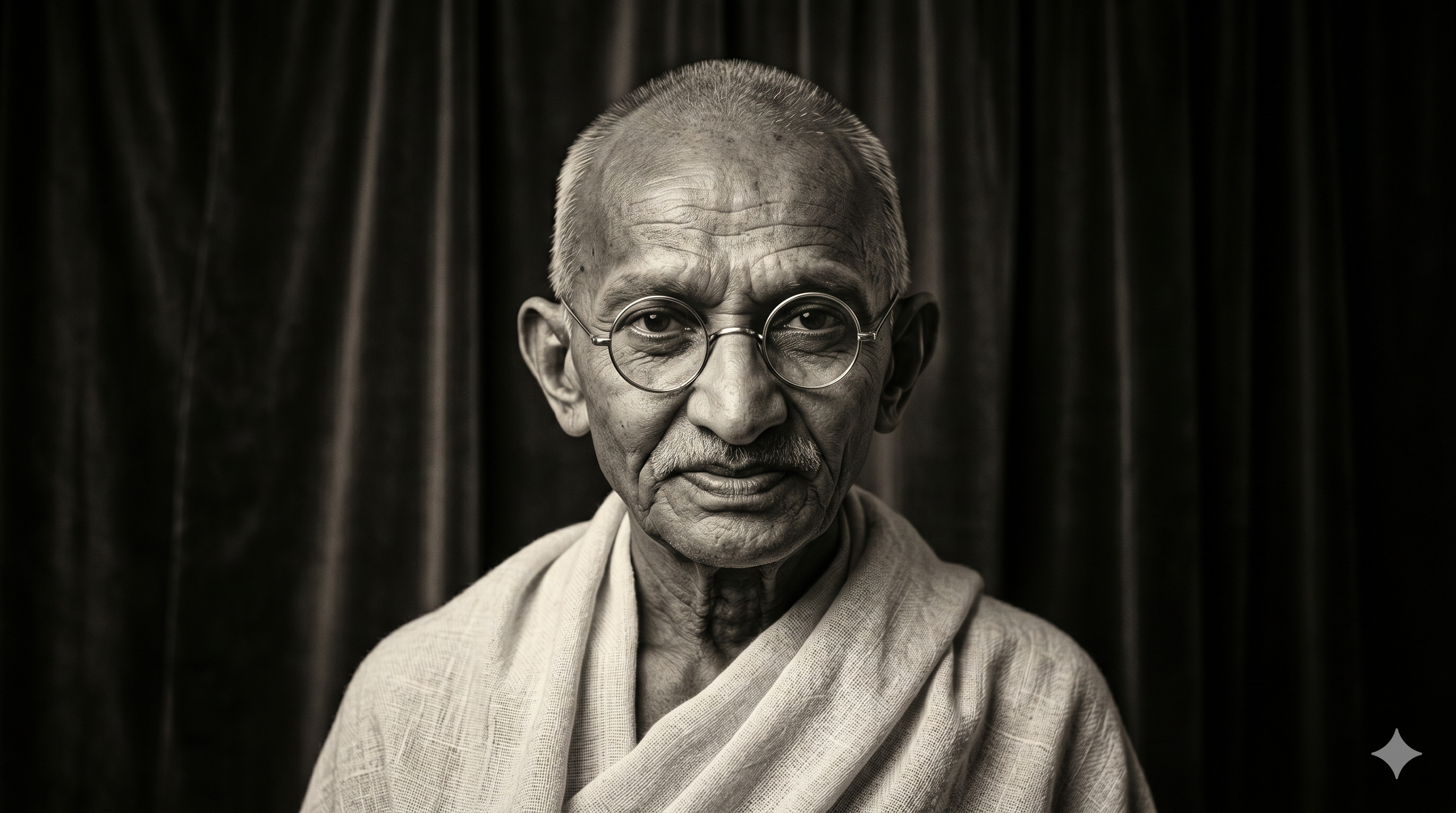
Mahatma Gandhi was one of the most influential leaders in modern history. Through the power of truth, discipline, and non-violence, he led India’s freedom struggle against British rule and inspired civil rights movements across the world. His life proved that moral courage can defeat political power.
Quick Facts
Full Name: Mohandas Karamchand Gandhi
Born: October 2, 1869 (Porbandar, British India)
Died: January 30, 1948 (New Delhi, India)
Family: Wife Kasturba Gandhi; Sons Harilal, Manilal, Ramdas, Devdas
Nationality: Indian
Field of Influence: Civil Rights, Politics, Ethics, Anti-Colonialism
Occupation: Lawyer, Freedom Fighter, Social Reformer
Known For: Salt March, Quit India Movement, Non-Violent Resistance
Golden Era: 1915–1948
Net Worth: Not Applicable (Lived in simplicity)
Primary Inspiration: Bhagavad Gita, Jainism, Leo Tolstoy, Henry David Thoreau
Famous Quote: "Be the change that you wish to see in the world."
Early Life
Gandhi was born in Porbandar, Gujarat, into a middle-class family. He was a shy child and average student, but his mother’s spiritual discipline deeply influenced him. Her values of truth, vegetarianism, fasting, and tolerance shaped Gandhi’s future character.
He married Kasturba Gandhi at the age of 13, as was common in that era.
Education
Gandhi studied law in London at the Inner Temple and qualified as a barrister in 1891. His years in England exposed him to new philosophies, Western thinkers, and legal systems that later influenced his political methods.
Career Beginning
In 1893, Gandhi moved to South Africa for legal work. There he faced brutal racial discrimination. The famous incident where he was thrown off a train in Pietermaritzburg became the turning point of his life.
That humiliation transformed him from a lawyer into an activist.
Rise to Greatness
Gandhi developed the philosophy of Satyagraha, meaning truth-force or soul-force. Instead of violence, he believed injustice should be challenged through peaceful resistance, sacrifice, and moral courage.
When he returned to India in 1915, he soon became the face of the independence movement.
Major Achievements
1. Led India’s Freedom Struggle
He mobilized millions of ordinary Indians against British rule.
2. Salt March (1930)
He marched 240 miles to protest the British salt tax, creating global headlines.
3. Quit India Movement (1942)
Demanded immediate British withdrawal from India.
4. Inspired Global Leaders
His methods later inspired Martin Luther King Jr., Nelson Mandela, and many others.
Biggest Struggles
Hindu-Muslim divisions
British repression and imprisonment
Internal political disagreements
Violence during Partition of India
Personal sacrifices and fasts for peace
Career Peak
Gandhi’s most powerful years were between 1915 and 1948, when he became the moral center of India’s freedom movement. Few leaders in history commanded such respect without holding official power.
Habits and Personality
Practiced silence on certain days
Spun his own cloth (Khadi)
Lived simply with minimal possessions
Strict vegetarian diet
Deep self-discipline
Humble but fearless personality
Fun Facts
Nominated for the Nobel Peace Prize five times
Never held government office
Time Magazine Person of the Year (1930)
Wrote thousands of letters
Walked long distances regularly
Controversies
Some of Gandhi’s early writings in South Africa have been criticized. Historians also debate aspects of his personal experiments with celibacy and communal life. These discussions continue alongside recognition of his historic achievements.
Legacy and Global Impact
Gandhi changed the meaning of political power. He showed the world that an empire could be challenged without weapons. His methods became the blueprint for future civil rights and justice movements worldwide.
He remains known as the Father of the Nation in India.
Life Lessons From Gandhi
1. Discipline Creates Strength
Real power starts with self-control.
2. Means Matter
How you win is as important as winning.
3. Courage Is Not Violence
Standing peacefully against injustice requires immense bravery.
4. Simplicity Can Be Powerful
A simple life can create extraordinary influence.
Final Verdict
Mahatma Gandhi was more than a political leader. He was a symbol of conscience, resilience, and peaceful revolution. His life continues to remind humanity that truth and courage can transform nations.
Free Download
Get The 2026 Tech Career Roadmap
A free PDF guide — the skills, salaries, and strategies to level up your tech career in 2026.
Drop your email and we'll send it straight to your inbox.