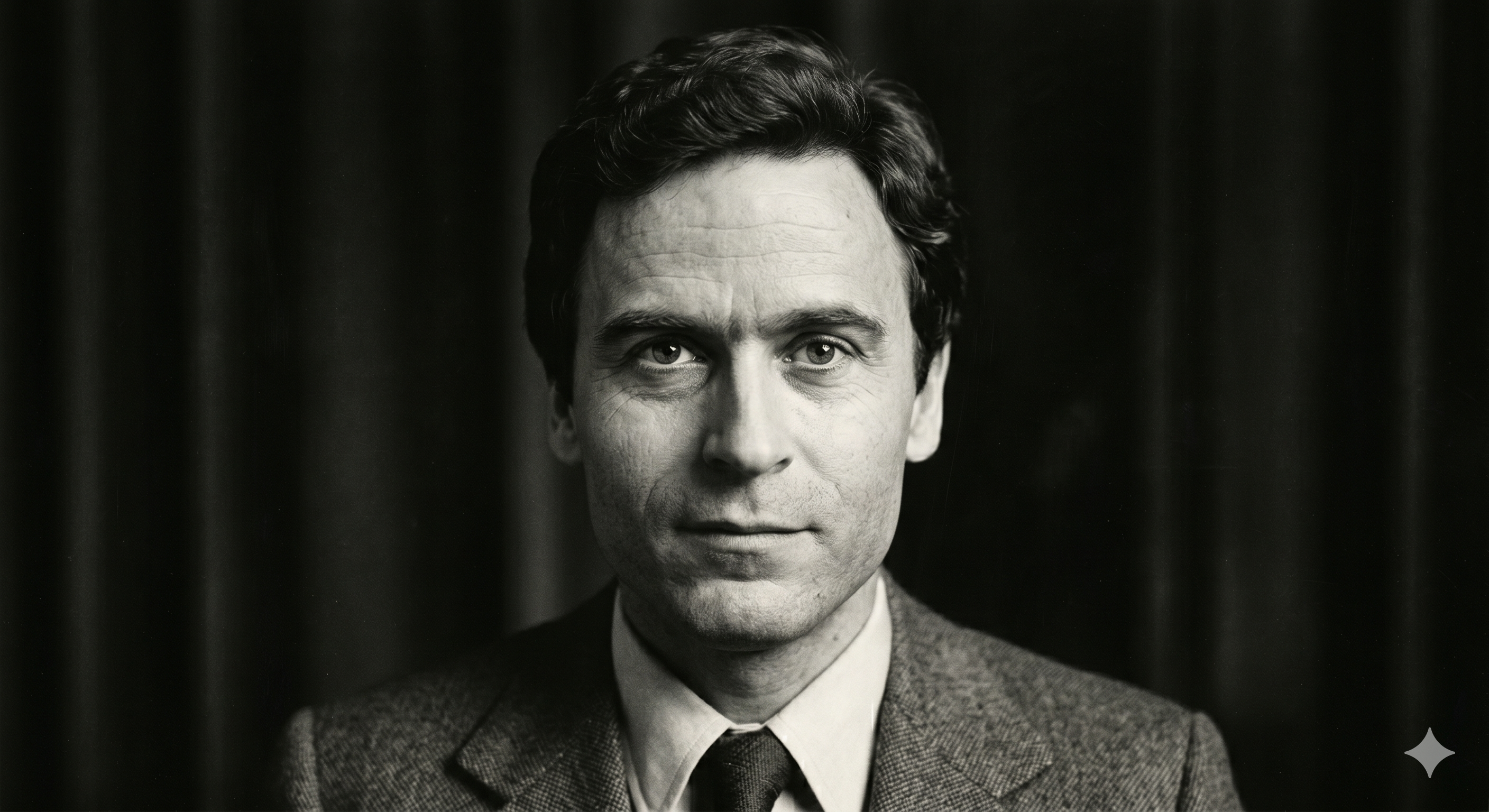
Ted Bundy was one of the most infamous serial killers in American history. His case shocked the public because he did not fit the common image of a violent criminal. Intelligent, articulate, and outwardly charismatic, Bundy revealed how dangerous predators can hide behind a normal appearance.
Quick Facts
Full Name: Theodore Robert Bundy
Born: November 24, 1946 (Burlington, Vermont, USA)
Died: January 24, 1989 (Executed in Florida, USA)
Family: Mother Eleanor Louise Cowell; Daughter Rose Bundy
Nationality: American
Field of Influence: Criminal History, Forensic Psychology, Law Enforcement
Occupation: Student, Law Student, Serial Killer
Known For: Murders across multiple U.S. states, prison escapes, televised trial
Golden Era: 1974–1978
Net Worth: Not Applicable
Primary Context: Criminal pathology and manipulative behavior
Famous Quote: "I'm the most cold-hearted son of a bitch you'll ever meet."
Early Life
Bundy was born to an unmarried mother and spent much of his childhood believing his grandparents were his parents and his mother was his sister. The later discovery of the truth has often been discussed by psychologists studying his personality development.
He appeared socially normal in youth and was considered intelligent and capable.
Education
Bundy attended the University of Washington, earning a degree in psychology. He later studied law at the University of Puget Sound but did not complete his degree.
Public Persona
One of the most disturbing aspects of Bundy’s case was how ordinary he seemed.
He Was Often Described As:
Intelligent
Well-spoken
Educated
Calm under pressure
Socially presentable
These traits helped him gain trust and avoid suspicion.
Criminal Activity
During the 1970s, Bundy committed a series of murders across several U.S. states. He confessed to multiple killings before his execution, though the exact number remains debated.
His crimes involved deception, kidnapping, violence, and attempts to evade capture.
Turning Point
His arrest in Utah in 1975 for attempted kidnapping helped connect him to other unsolved cases. Investigators began piecing together a multi-state pattern.
Prison Escapes
Bundy became notorious for escaping custody twice.
Famous Escapes
Jumped from a courthouse library window
Escaped through a ceiling opening in jail
These escapes intensified national attention.
Trial and Media Attention
Bundy’s Florida trial became one of the first nationally televised criminal trials in America. It created enormous media fascination and also raised ethical concerns about turning criminals into public spectacles.
He even acted as part of his own defense.
Habits and Personality Traits
Psychologists and investigators often described Bundy as:
Narcissistic
Highly manipulative
Emotionally detached
Skilled at deception
Lacking empathy
Legacy
Ted Bundy remains one of the most studied criminal cases in modern history.
His Case Influenced:
FBI behavioral profiling
Multi-state law enforcement cooperation
Public awareness of predatory behavior
True crime media culture
How the World Changed After His Crimes
1. Better Police Coordination
Agencies improved information sharing across states.
2. Public Safety Awareness
People became more cautious about strangers and deceptive behavior.
3. Criminal Psychology Research
Bundy’s case became central in studying psychopathy and serial offenders.
4. Media Ethics Debate
His trial sparked questions about glamorizing violent criminals.
Life Lessons
1. Charm Is Not Character
Outward confidence can hide dangerous intentions.
2. Trust Should Be Balanced With Awareness
Manipulators often rely on appearances.
3. Systems Must Communicate
Shared information can prevent repeated harm.
4. Media Attention Has Consequences
Public fascination with criminals can distort reality.
Final Verdict
Ted Bundy’s story is not one of admiration, but warning. His case exposed how violence can hide behind normalcy and permanently changed criminal investigation, psychology, and public awareness.
Free Download
Get The 2026 Tech Career Roadmap
A free PDF guide — the skills, salaries, and strategies to level up your tech career in 2026.
Drop your email and we'll send it straight to your inbox.